
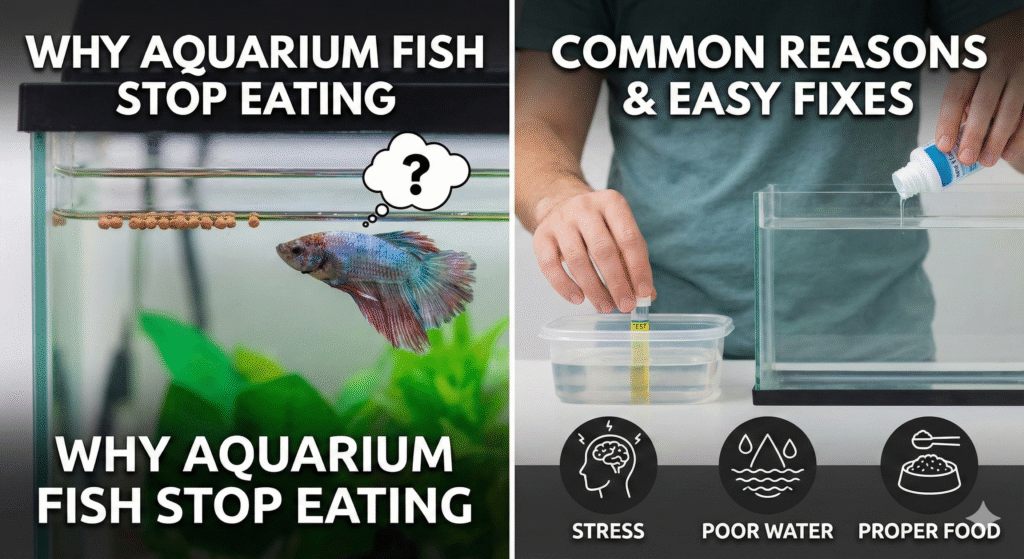
When you have kept fish for some time, you realize quite quickly that feeding time is one of the best times. Your fish eagerly swim, awaiting food. So when they suddenly stop eating, it clearly means something is not right. Many beginners panic, but the good news is that most feeding problems are quite easy to fix once you know the cause .Below is a simple, direct guide explaining why fish stop eating and what you can do to help them start again.
1. Water Quality Problems
One of the most frequent reasons fish refuse food is poor water quality. Dirty and toxic water makes fish stressed, weak, and not as active. Just imagine trying to eat in a polluted room; you would not feel hungry either.
What causes bad water?
Ammonia or nitrite too high
Overfeeding
Not changing the water for many days.
Filter not cleaned properly
How to fix it
Perform a 30–40% water change
Clean the filter sponge gently in old tank water
Use a test kit and ensure the ammonia and nitrite are at 0
Avoid overfeeding for a few days.
Clean water can often restore appetite in 24–48 hours.
2. New Tank Syndrome
If your aquarium is newly set up, it may be a while before your fish eat properly over the first few days. The tank bacteria are not yet stable and the fish feel stressed in their new home.
Signs
Hiding fish
Cloudy water
Fish eating little or nothing
How to fix it
Keep lights off for the first day
Feed very scanty quantities
Do small water changes (20%)
Add liquid beneficial bacteria
As the tank stabilizes, your fish will start eating more normally.
3. Stress From Transport or New Environment
Whenever fish are transferred from one tank to another, they suffer from stress. Even something as simple—like changing their position in the room—can affect their appetite.
Causes of stress
New fish added
Lights too bright
Tank in a noisy area
Too much movement around the aquarium
How to fix it
Keep lights dim for 1–2 days
Reduce nearby noise
Give them places to hide: plants, caves
Avoid disturbing the tank
Most fish will resume feeding once they feel safe.
4. Incorrect water temperature
The temperatures should be such that allow fish to be active and feed properly. In very cold or very hot water, fish lose their appetite.
Ideal temperatures
Betta: 26–28°C
Guppy: 24–27°C
Tetra: 23–26°C
Goldfish: 20–23°C
Correct
Use a heater (for tropical fish)
Avoid temperature fluctuations
Avoid sudden drops in temperature when changing water
Once the temperature is right, their appetite usually improves quickly.
5. Food Type Problem
Sometimes the problem is simply the food. Old, expired, or low-quality food loses smell and taste. Fish get bored with the same food every day, too.
Signs of food problem
Fish taste the food but spit it out.
Floaty food sinks too fast
Pellets too big
Fix
Try a different brand
Offer variety: flakes, pellets, freeze-dried, frozen
Crush pellets for small fish
Avoid expired food
Changing their food often solves the problem overnight.
6. Overfeeding
Ironically, fish stop eating when overfed. The food is wasted, decays, pollutes the water, and they lose their appetite.
Fix
Feed only what they finish in 20–30 seconds
First, stop feeding for 24 hours.
Clean the bottom of the tank.
Giving them a break helps their digestion reset.
7. Sickness or Infection
Sick or injured fish naturally stop eating. This is a protective behavior.
Common symptoms
White spots Ich
Clamped fins
Kembung perut
Red gills
Slow swimming
Fix
Isolate the ailing fish in a hospital tank
Keep water warm and clean.
Take the right medication
Avoid overfeeding until complete recovery is noted.
Once they start feeling better, their appetite gradually returns.
8. Aggressive Tank Mates
This does happen when you have different species in one tank, and the gentle ones may feel scared to come out and eat.
Symptoms
Fish hiding behind filter
Larger fish chasing the smaller ones
Fish eat only when the others are far away.
Fix
Rearrange the ornamentation
Add more hiding spaces
Remove or separate aggressive fish
Feed at different corners
Peaceful tanks = healthy appetite.
9. Water Change Shock
Sometimes, fish stop eating after a big water change; this is when the new water is either too cold, too warm, or added too fast.
Correct
Match temperature before adding new water
Add water slowly
Use dechlorinator every time
Do smaller, more frequent water changes
Once the water settles, your fish will go back to their routine.
Final Thoughts
Fish not eating is one of the scariest things for beginners, but in most cases, there is a very simple and fixable reason. Always check the water quality first, followed by temperature, food, and stress factors. With clean water and a relaxed environment, they usually start eating again. If your fish still won’t eat after 3–4 days, it could be a health issue and needs closer observation.
Pingback: How to Keep a Nano Tank Crystal Clear (Beginner Cleaning Guide)