
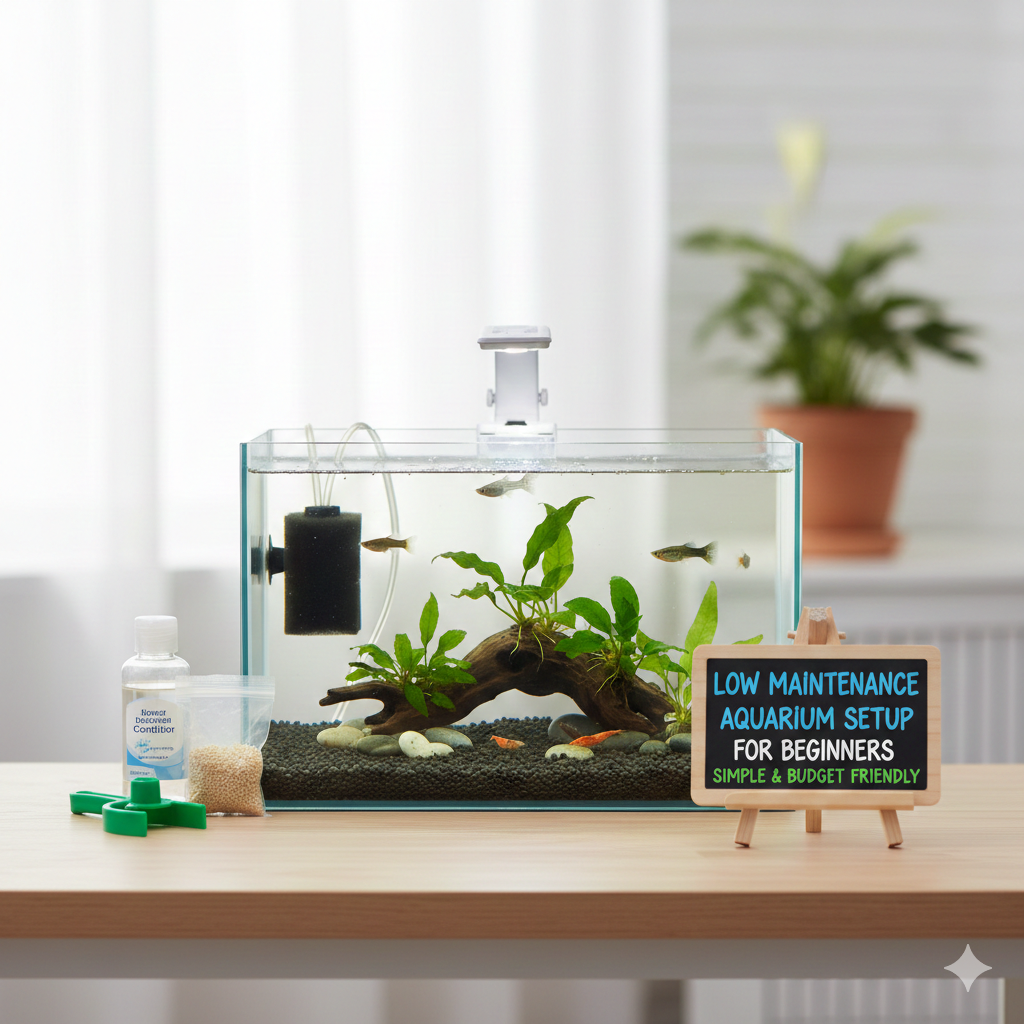
Now, you’re intrigued with the calming beauty of an aquarium, yet the thought of complicated equipment, frequent water tests, and the required cleaning time discourages you from this hobby? Well, rest assured that you’re not the only one who believes the installation of a thriving aquarium entails a tremendous investment and a Marine Biology Degree!
Well, good news: it doesn’t
This guide is meant to help a complete newbie set up a gorgeous, thriving, and, most critical of all, low-maintenance aquarium system that won’t put a dent in the ol’ checkbook or suck the time out of your weekends. We’re talking no-frills solutions here, folks.
Part 1: The Foundation – Tank & Location
The biggest mistake beginners make is starting too small. It sounds counterintuitive, but a slightly larger tank is actually easier to maintain because the water parameters (temperature, $\text{pH}$, ammonia, nitrite, nitrate) are more stable.
1. Tank Size: Bigger is Better for Beginners
Minimum Recommendation: The minimum system will require a tank with a capacity of 20 gallons. While a 10-gallon is less expensive, it is notorious for being extremely difficult to maintain. A tank of 20 gallons is much more stable.
Budget Option: Look for the “tank only” sales promotion, or find a gently used tank that is leak-free, of course. Starter kits can be very convenient, but the assembly is usually not of the highest quality and will end up getting replaced.
2. Strategic Location
The placement of your tank is crucial for low maintenance.
Avoid Direct Sunlight:
Sunlight promotes excessive algae production. It becomes quite annoying to clean this algae. It is essential to place such tanks in a region allowing natural light but not direct sunlight.
Stable Surface: Make sure the surface is level and firm. A 20-gallon tank with enough water, gravel, and decorations to fill it weighs more than 200 pounds!
Proximity to Power/Water
Pick a location that is close to a grounded electrical outlet and also where water change-overs can be accomplished easily, preferably located near a bathroom or a utilities sink.
Part 2: Essential Equipment (Keep It Simple)
You only need four key pieces of equipment. Resist the urge to buy everything you see at the pet store!
1. Filtration: The Workhorse of Low Maintenance
A quality filter is considered the #1 essential element. Filters can include mechanical (eliminates particles), chemical (decolorizes/remove odor), and most importantly, biological (transmutes toxic waste) filtration. A properly designed filter can eliminate sewage
Best for Beginners: Hang-On-Back Filter: The Hang-On-Back filter, or HOB filter, is the
Key Feature : You can locate a filter suitable for a tank size one size larger than your actual tank (for example, a 30-gallon filter for a 20-gallon tank) and it will provide extra power for cleaning.
Maintenance Tip: It is important to simply rinse your filter sponges or media in the used tank water when performing a water change. You must never use tap water, as the chlorine will eliminate the beneficial bacteria required for the nitrogen cycle.
2. Heater & Thermometer: Stable Temperature
Most popular tropical fish need consistent warmth.
Heater: A basic submersible heater with an adjustable thermostat is necessary. Use about 5 watts per gallon (a 100-watt heater is best for a 20-gallon tank).
Thermometer: A stick-on thermometer will not provide an accurate reading. Instead, a glass thermometer that floats or sinks will help to accurately measure the temperature
3. Lighting: Keep it Modest
Lighting Lighting is required only as a light source so that one views the fish and, if one wishes, grows vegetation. Simple Fix: An elementary LED light hood fix or similar is adequate. Thus, there is no need to break the bank on bright lights unless one wishes to grow high-intensity vegetation. Prevent Algae Growth by turning on your light only 6-8 hours. Utilize an automated timing plug.
Part 3: The Decor & Substrate
1. Substrate (The Tank Floor)
The substrate choice can affect maintenance.
Low-Maintenance Choice: Use simple, inert gravel or dark sand. These are cheap, easy to vacuum, and look good. Avoid fine white sand, which shows every bit of debris, making the tank look dirty quickly.
Rinse First! Rinse gravel or sand thoroughly in a bucket until the water runs clear before putting it in the tank. This prevents cloudy water for days.
Pingback: Best Nano Tank Setups for Small Aquariums