
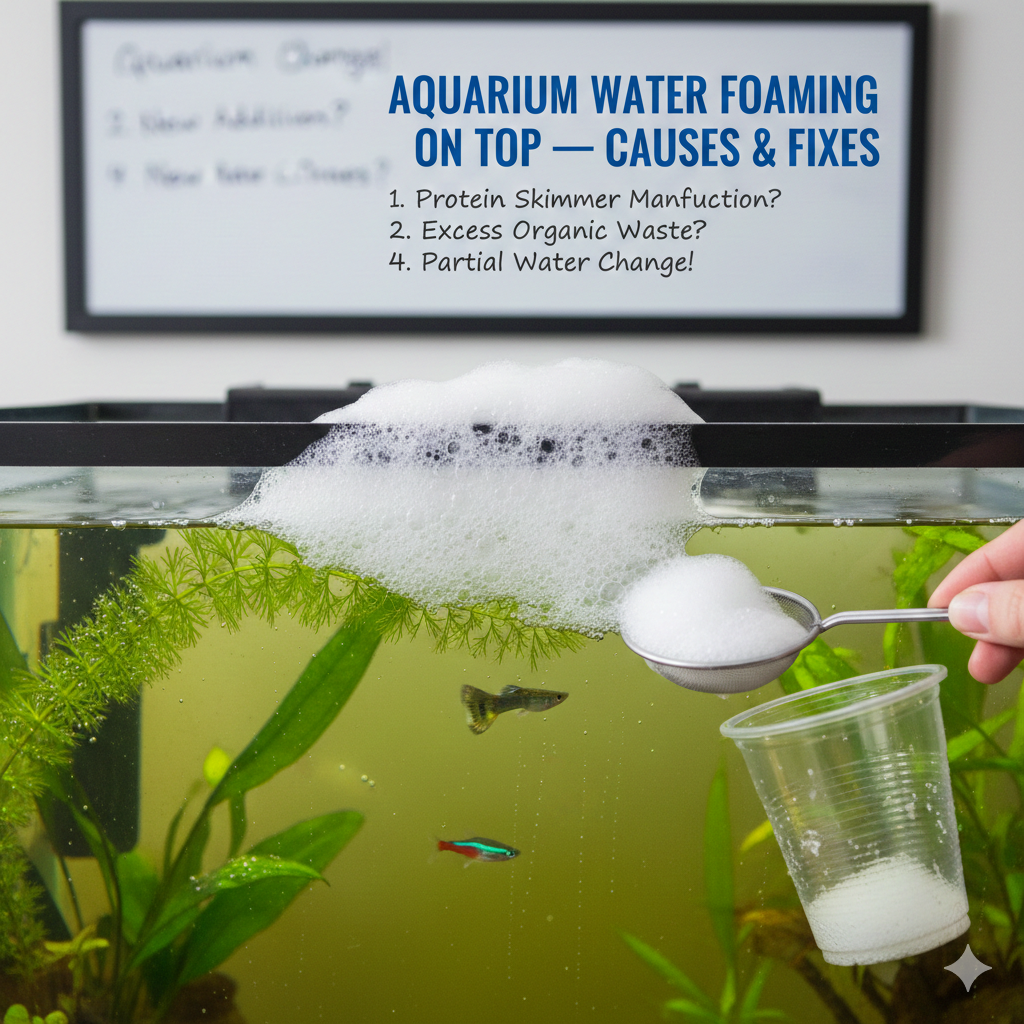
Seeing foam on the surface of your aquarium can feel weird, especially when the rest of the tank looks fine. Sometimes it’s just a harmless film, and sometimes it’s a sign that something in the tank isn’t balanced. The good thing is that foamy water is usually easy to understand once you know what’s behind it.
Let’s go through the real reasons your aquarium forms foam and how you can get rid of it without stressing.
Protein Build-Up (Most Common Cause)
This happens in almost every tank eventually. When leftover food, fish waste or plant debris breaks down, they release proteins into the water. When those proteins reach the surface and get mixed with bubbles (from your filter or aeration), they form foam.
It looks messy but is totally fixable.
A quick clean, removing dead leaves, and doing a small water change usually reduces it fast.
Overfeeding Creates Surface Foam
Fish don’t need as much food as we think. When you give too much, the food breaks apart and creates a thin film that traps bubbles. Within a day, the top of the tank gets foamy.
Signs it’s overfeeding:
• Food sits on the surface after feeding
• The tank smells slightly off
• Foam appears after feeding time
Just cut feeding by half for a few days and the foam usually fades.
Dirty Filter or Weak Flow
If your filter isn’t pulling waste properly, everything stays in the water and rises to the surface. That trapped waste forms foam whenever the filter output hits the surface.
Also, pipes and sponges full of gunk make the flow weaker, and weak flow means the surface isn’t breaking enough perfect conditions for foam.
A quick rinse of the sponge in old tank water usually solves this.
Newly Added Water or Water Conditioner
Sometimes foam appears right after a water change. Tap water can contain air mixed under pressure, and when it enters your tank, it creates bubbles that stick together. Water conditioners also sometimes cause temporary bubbles. It’s harmless and usually disappears in a few hours.
Fish Breeding Behavior (Bubble Nests)
This is especially common with bettas, gouramis and other labyrinth fish. They build bubble nests, which can look like soap bubbles on the surface. If you see your male fish hanging around the bubble patch, guarding it, that’s a nest not foam from a problem.
Don’t disturb it. It’s normal.
Medications or Fertilizers
Some meds or plant supplements change the surface tension of water. When the filter hits the surface, the bubbles clump together into foam. Again, usually harmless and temporary.
Low Maintenance or Old Tank Syndrome
Foam can also appear when the tank hasn’t been cleaned in a while. Waste slowly builds up even if the water looks clear. The foam is your first warning sign that the tank needs attention.
A gentle cleaning and small water change usually fixes it.
How to Fix Aquarium Foam Quickly
Here’s what helps most tanks:
• Do a small water change
• Clean the filter sponge gently
• Reduce feeding
• Remove dead leaves and waste
• Increase surface movement
• Add an air stone if oxygen feels low
Most foam disappears in a day once the cause is removed. If it stays for longer, check for hidden waste under decorations or in the substrate.
Final Thoughts
Foam on top of aquarium water isn’t usually a serious problem. It’s often just proteins, food waste or surface tension changes. Fix the root cause and the foam fades on its own. A healthy tank with steady water changes and good filtration rarely has foam issues for long.