
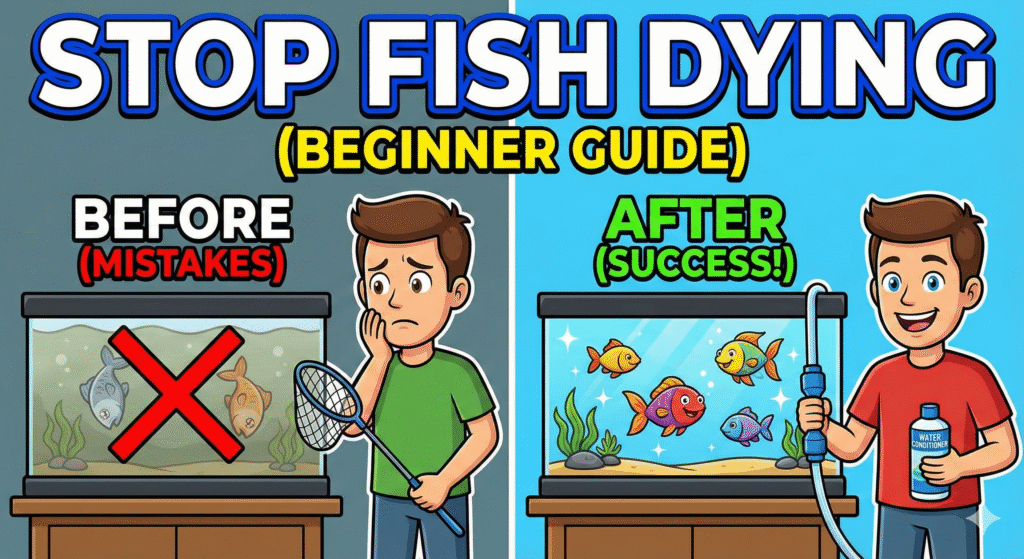
A water change should make your aquarium cleaner and healthier. But many beginners get shocked when fish suddenly become weak, stressed, or even die right after changing the water. This can be confusing and scary, especially when everything seemed fine before. The truth is, fish don’t die because of the water change itself—they die because something about the new water is very different from their old water. When the change is too fast, the fish’s body cannot adjust.
In this guide, you’ll learn why this happens and the simple steps you can follow to make water changes safe every time.
1. Changing Too Much Water at Once
The most common reason fish die after a water change is removing too much water. When you change more than 50–70% at once, the water chemistry changes suddenly. Fish are sensitive to these changes, especially temperature, pH, and minerals.
What happens
Fish get shocked by sudden changes
Their gills cannot adjust quickly
Stress weakens their body
How to fix it
Do smaller water changes:
20–25% once a week is perfect
30–40% if the tank is dirty
Avoid making 80–100% changes unless it’s an emergency.
2. Not Using Water Conditioner
Tap water contains chlorine and sometimes chloramine. These chemicals are safe for humans but deadly for fish. Even a small amount can burn fish gills.
Symptoms of chlorine shock
Fish blowing at surface
Difficulty breathing
Sudden death following change of water
Solution
Always add a good water conditioner before putting tap water into the tank. This removes chlorine instantly.
Conditioner is used every time without fail.
3. Temperature Shock
Fish can survive many things, but sudden temperature change is extremely dangerous. Even a 3–5°C difference can stress them.
Signs
Fish acting erratically
Lying at the bottom
Not eating
Labored breathing
How to fix it
Match the temperature of new water to the tank water:
Use your hand for comparison
Or use a thermometer
New water should be identical in feel to the tank water
Never add directly hot or very cold water.
4. Over-Cleaning of the Filter
Your filter holds beneficial bacteria that protect fish by removing ammonia and nitrites. When you wash the filter under tap water or replace all the media at once, you accidentally remove the good bacteria. After a water change, ammonia rises and harms fish.
What to do instead
Rinsing of filter media in old tank water
Never change all media at one time.
Clean the filter lightly
Never wash with soap
Healthy bacteria = safe water for fish.
5. Over agitation of the substrate
During water changes, some people mix or stir the gravel very hard. This releases trapped waste, gases, and ammonia into the water.
History
Water becomes turbid
Fish act stressed
Bad Odour
How to clean gravel safely?
Use a gravel vacuum gently
Clean in small sections.
Don’t stir all the bottom at once
6. Overfeeding After a Water Change
Some beginners feed their fish right after the water change, thinking the fish are hungry. But fish are already a bit stressed after any change.
Feeding too soon causes:
Food wasted
Ammonia rise
Murky water
Weakened fish
Better option
Wait 1–2 hours after a water change before feeding
7. Using Dirty Buckets or Soap
Buckets previously used for detergent or chemicals can release harmful residue into the aquarium.
Solution
Use a “fish-only” bucket
Never use soap to clean aquarium items.
Rinse tools with hot water only
8. Failure to Match the pH
Sometimes the tap water has a very different pH from your aquarium. A sudden pH shift can shock the fish.
How to avoid this
Test Tap Water pH Once
Don’t unnecessarily attempt to adjust pH
Gradually make changes
Stable water is more important than perfect numbers.
How to Do a Safe Water Change (Step-by-Step)
Here is a simple routine that keeps fish safe and healthy:
Step 1: Switch off all the equipment.
Unplug filter and heater to avoid any damage.
Step 2: Evaporate 20–25% of water
Don’t take out too much at a time.
Step 3: Vacuum the surface of the gravel
Do it gently and do not dig too deep.
Step 4: Fresh water preparation
Add water conditioner
Match temperature
Use a clean bucket
Step 5: Add water slowly
Pour slowly to avoid stressing fish and stirring debris.
Step 6: Turn equipment back on
Let the filter settle the water.
Step 7: Feed later, not immediately
Give fish time to relax.
Final Words
Fish dying after a water change does not mean you did something terribly wrong. It simply means something changed too quickly for them to handle. Once you control temperature, chlorine, and water chemistry, your fish will stay safe and healthy. Small, steady water changes are always better than big ones. With a simple routine, your tank will stay clean and your fish will remain stress-free.
Pingback: red eared slider care guide: Tank Setup, Diet & Common Mistakes