
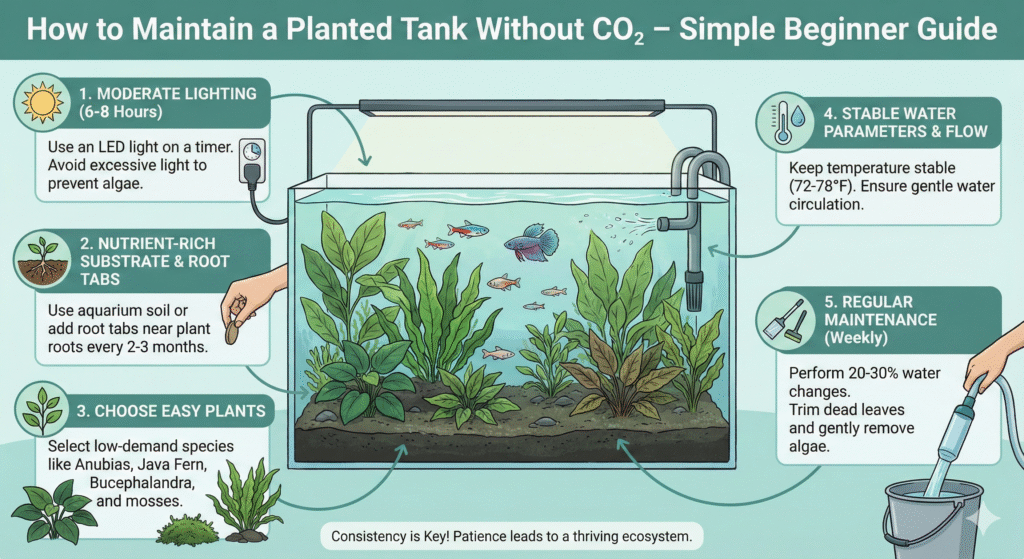
How to Maintain a Planted Tank Without CO₂
Keeping a planted tank without CO₂ may sound daunting, but actually, many beautiful aquariums run perfectly fine without fancy equipment. You do not need pressurized cylinders, diffusers, or other complex setups to grow healthy plants. What you actually do need is a little understanding of how plants grow and how to balance lighting, nutrients, and water changes. Once you learn that balance, maintaining a low-tech planted tank will be very easy.
This guide will walk you through everything in simple, clear English, so you can set up and maintain your CO₂-free planted aquarium with confidence.
Choose Plants That Grow Well Without CO₂
Not all plants require CO₂. Some are slow growers but remain healthy and green even in low-tech setups.
Here are the best low-maintenance plants:
Anubias – extremely hardy, growing very slowly, doesn’t require strong light.
Java Fern – It grows on wood or rock, great for beginners.
Cryptocoryne — many varieties, very suitable for natural layouts
Vallisneria – Long grass-like leaves, spreads easily
Hornwort – fast grower, floats or can be planted
Amazon Sword – Hardy beginner plant, excellent for larger tanks
Water Wisteria – Fast growing even without CO₂
They require no special care inasmuch as these plants naturally adapt to low light and low nutrient systems.
Use the Right Lighting (Very Important)
In a no-CO₂ tank, lighting decides if your plants grow or algae take over.
Keep these simple rules:
Use low to medium light
Keep the light ON for 6–8 hours only
DO NOT use overly bright bulbs or LED bars
Never run light for 10–12 hours, as that causes algae.
Remember:
Low light = slow plant growth = fewer problems. Planted tanks without CO₂ grow best when you give plants time to adjust instead of forcing fast growth.
Go for a Good Substrate
You don’t need expensive soil, but a nutrient-rich base is a great help for plants.
Best choices for low-tech tanks:
Aquarium soil (budget or standard)
Enriched gravel
Sand with root tabs
Adding root tabs with rooted plants like crypts or swords every 2–3 months will keep them healthy.
Begin with a light fertilization regime.
Even without CO₂, plants still need nutrition. But the goal is balance-not too much, not too little.
Follow this easy procedure:
Add liquid fertilizer once a week.
Use root tabs under heavy root feeders
Skip fertilizer if algae are growing rapidly.
Don’t over-feed the tank with nutrients. The plants in a low-tech tank grow very slowly and don’t require heavy dosing.
Regular Water Changes Keep Everything Stable
Water changes remove waste buildup, prevent algae, and give the plants a new supply of minerals.
Follow this schedule:
Change 25–30% water every week
Clean the glass lightly
Vacuum only the surface of gravel, without disturbing the planted soil.
Stable water = healthy plants.
Don’t Overcrowd the Tank With Fish
Fish produce nutrients through waste, but too many fish create imbalance and algae.
Come to a small, tranquil town:
Tetras
Guppies
Rasboras
Small barbs
Shrimp
Snails
A balanced fish load will help your tank stay clean without CO₂.
Avoid Common Mistakes
Beginners often make small mistakes that lead to algae or dying plants. Here’s a list of things to avoid:
❌A Using extremely bright lights
❌ Keeping lights on for more than 8 hours
❌ Application of excess fertilizers
❌Avoid planting species that require high CO₂ levels.
❌ Cleaning the substrate too deeply
❌ Sudden change in light or fertilizer routine A slow-and-steady approach always works in a low-tech aquarium.
Trim Plants Regularly
Even slow-growing plants will require trimming. Trimming the old leaves promotes new growth and keeps the tank looking clean.
Trim these more often:
Wisteria
Hornwort
Vallisneria runners
Trim these occasionally:
Anubis
Java Fern
Crypts
A well-trimmed tank is healthy and neat.
Add Floating Plants for Extra Stability
Floating plants are like natural filters. They absorb the extra nutrients and reduce algae.
Best floaters:
Duckweed (fast, but messy)
Frogbit
Water lettuce
Salvinia
These floaters also block harsh light, creating a comfortable environment for fish.
Be Patient – Low-Tech Tanks Grow Slowly
A no-CO₂ planted tank does not change overnight. It takes a few weeks or even a couple of months for the plants to settle, adapt, and start growing well.
During the first month, you might experience:
Slower growth
Some leaves melting-normal for crypts
Slight algae (normal )
With time, your tank will balance itself.
Final Thoughts
In fact, keeping a no CO₂ planted tank is not only possible but highly suitable for complete beginners. It doesn’t require expensive gear or advanced knowledge. In fact, it will get by on the simple routine of low light, good substrate, light fertilizing, weekly water changes, and hardy plants.
A low-tech planted aquarium grows slowly, looks natural, and is stable for a very long time. With patience and a balanced approach, it’s very easy to get a healthy green underwater garden with no CO₂ system.